
Saturday, 30 June 2012
Fashion Knowledge: Long Live Versace @ 00:28
Today's fashion history (and fashion present) lesson is on the genius and legacy behind the ultimate glitzy fashion house, Gianni Versace.
Remember Versace?
Remember Versace?
 |
Yep, this was it! The famous Versace dress that not only solidified Jennifer Lopez's glam sex appeal on the red carpet, but an out-of-the-box approach to fashion!
Seeing the Gianni Versace label in all it's glamour and luxury today, it's hard to believe that the designer that created the label had a rickety start. Gianni Versace was born in Reggio Calabria, Italy in 1946. An aspiring couturier, he moved to Milan in 1972 and worked for multiple companies as a freelance designer. It wasn't until March 28th, 1978 did he launch his own label at the Palazzo della Permanente in Milan. With his sister Donatella as his muse and model, his brother Santo handling the business portion of the label and his brother-in-law Paul Beck supporting him to the fullest, Versace, was a family business that would be a powerful fashion force.
Gianni Versace's headstrong attitude and persistent fashion ideals was a prominent part of the 1990s. With him at the reigns of the fashion industry, Versace brought sex, over-the-top glamour and publicity to fashion. His wearers included the most popular rock-and-roll musicians like Bruce Springsteen, Sting, Prince, Eric Clapton and George Michael. He also won the likes of supermodels, the world's most famous stars and Diana, the Princess of Wales. Elton John even wore Versace dresses for The Sunday TImes in a spoof of Versace's previous advertising campaigns.
The first Gianni Versace haute couture fashion show was in 1990, in Paris at the famous Ritz hotel. Only success followed that major move. The designer had the world at his feet, making a turnover of 600 billion lire. Although his vision for fashion was a driving might, he was earnest, telling Women's Wear Daily in 1990, "In Italy, I cannot compete with anybody. There are only three designers who give me the energy to fight - Yves Saint Laurent, Christian Lacroix and Karl Lagerfeld."
Gianne Versace was shot outside his Miami Beach mansion and tragically killed on July 15th, 1997. He was designing a collection with his sister Donatella Versace, and after his death, Donatella mustered up the courage to carry on and finish the collection. Donatella was given her own line, Versus, in 1989 because Gianni wanted a different, more edgier and youthful perspective. Having been working in that high-octane fashion house since almost right after its conception, Donatella Versace took over as the house's creative director after Gianni's death. She has since worked tirelessly to keep the fashion industry flashy and fearless. Even to this day, she strengthens Versace's unique fashion vision, keeps collection distinguished and ensures that the family business remains front and centre as it has for decades.
Versace's signature style is always present in every piece, no matter the collection. The monomers of the Versace collections have glitter, slink, boldness and a mixture of curve incorporated into it. They represent a those with a look-at-me attitude; for elites or women and men who embody the lifestyles of the fabulous to don. Described by Donatella herself in the 2012 Style Icons issue of Hello! Canada, "Versace is about the sophisticated woman who is elegant, not afraid of her own sensuality and not afraid to dare or take risks in life."


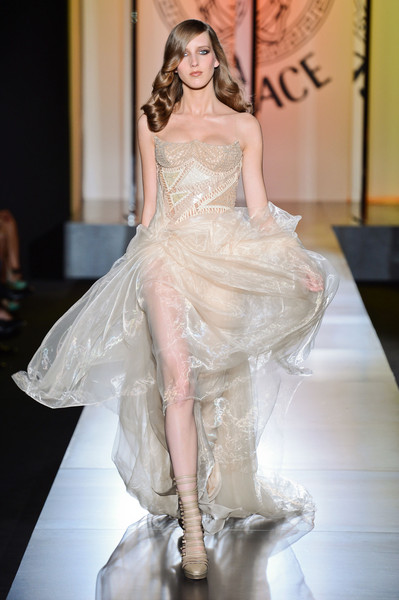


Versace and Atelier Versace Fall/Winter Couture 2012
Donatella now has the reigns and with Versace's legacy as the backbone of the business, this fashion house thrives beyond compare.
Labels: Fashion History and Knowledge
Monday, 25 June 2012
Fashion Knowledge: The Roaring Twenties @ 18:02
Hello hello,
Apologies for my being so out of touch with my blog lately. Final exams and provincials are officially over for the grade elevens! It's time to party...and blog! For the grade elevens in beautiful British Columbia, our only provincial exam this year is on social studies. And if you've been in school, you would know what a gigantic load of history is contained in that mentally exhaustive course. I know it's over, but since we had to be tested on historical happenings from the early 1920s to the 2000s, I might as start writing some outfit-inspiring posts on fashion knowledge!
Fashion history may seen like an obscured topic to the present fashion world sometimes, after all, the limitless, forward-moving creative force is keeping designers and fashionistas worldwide up-to-date with the present and predicting the motifs of the future. In my opinion though, there would be nothing new today without the vintage trends of the past. The history of fashion has not only created lasting legacies for the great fashion empire but has ultimately paved the way for startling trends nowadays.
Here's to the last year of mandatory social studies in high school!
The "Roaring Twenties" is my second favourite decade, pulling up right behind the 60s. I define it as the decade of multitudinous fashion movements. As young teenagers were pushing away the remnants of the WWI, a culture was born. A fun, young look was born to cover up the previous war-torn situation.
The 1920s was a decade of revolutionary
 change in fashion, catalyzed by various social
movements.
Women were becoming more involved in the community, in terms of the workforce, activism and even politics. They were a growing force and this factor influenced a revolving perspective towards fashion. In 1926, a gender bending concept existed, sparking new androgynous phrases like "the Garçonne frock" and the "boyish bob." These phrases paved the way for a different style; for instance, Chanel's masculine and unisex jumper. The divide between opposite genders was slowly disintegrating.
The 1920s was a decade of 'modern' style.
Just about everything seemed short and abbreviated in this time period. Say hello to Marg and Babs as they spill about the latest short skirts and shorter coats, while giving short credit about the designer who created the piece. People were clinging to the term 'modern' to describe outfits and furniture. It was the expression that was at the tips of everyone's tongues. What was 'modern' at the time was this: uncomplicated straight lines, bobbed or shingled hair, shapeless clothing, drop-waist dresses, cap-like hats, boyish bodies and flat breasts. Simplicity and freedom to move were significant concepts in the 20s. Gabrielle "Coco" Chanel was a rising star, blessing women with new, innovative designs that used jersey and kasha. She could be said to have ruled over women's dress in the 1920s.
 The 1920s was a decade that was topped
with piles of accessories.
Long strands of pearls, feathered fans
(for flirting ;)), huge plumes, plain bracelets,
huge pear-shaped stones, evening scarves
and cigarette holders delivered excitement
for historians.
The 1920s was a decade of fun and youthfulness.
A common symbol of the 1920s are flapper girls. Flapper girls were fashionable and did everything the 'modern' way. They were carefree and fun, wearing shapeless dresses that were shorter then average, used loads of makeup, wore their head short and smoked cigarettes to pass time. An epitome of the 1920s, these young women encouraged others to live life more freely after the war.
Need some inspiration for a jazzed up 1920s style? Check out these ideas below:

Apologies for my being so out of touch with my blog lately. Final exams and provincials are officially over for the grade elevens! It's time to party...and blog! For the grade elevens in beautiful British Columbia, our only provincial exam this year is on social studies. And if you've been in school, you would know what a gigantic load of history is contained in that mentally exhaustive course. I know it's over, but since we had to be tested on historical happenings from the early 1920s to the 2000s, I might as start writing some outfit-inspiring posts on fashion knowledge!
Fashion history may seen like an obscured topic to the present fashion world sometimes, after all, the limitless, forward-moving creative force is keeping designers and fashionistas worldwide up-to-date with the present and predicting the motifs of the future. In my opinion though, there would be nothing new today without the vintage trends of the past. The history of fashion has not only created lasting legacies for the great fashion empire but has ultimately paved the way for startling trends nowadays.
Here's to the last year of mandatory social studies in high school!
The "Roaring Twenties" is my second favourite decade, pulling up right behind the 60s. I define it as the decade of multitudinous fashion movements. As young teenagers were pushing away the remnants of the WWI, a culture was born. A fun, young look was born to cover up the previous war-torn situation.
The 1920s was a decade of revolutionary
 change in fashion, catalyzed by various social
 movements.
Women were becoming more involved in the community, in terms of the workforce, activism and even politics. They were a growing force and this factor influenced a revolving perspective towards fashion. In 1926, a gender bending concept existed, sparking new androgynous phrases like "the Garçonne frock" and the "boyish bob." These phrases paved the way for a different style; for instance, Chanel's masculine and unisex jumper. The divide between opposite genders was slowly disintegrating.
The 1920s was a decade of 'modern' style.
Just about everything seemed short and abbreviated in this time period. Say hello to Marg and Babs as they spill about the latest short skirts and shorter coats, while giving short credit about the designer who created the piece. People were clinging to the term 'modern' to describe outfits and furniture. It was the expression that was at the tips of everyone's tongues. What was 'modern' at the time was this: uncomplicated straight lines, bobbed or shingled hair, shapeless clothing, drop-waist dresses, cap-like hats, boyish bodies and flat breasts. Simplicity and freedom to move were significant concepts in the 20s. Gabrielle "Coco" Chanel was a rising star, blessing women with new, innovative designs that used jersey and kasha. She could be said to have ruled over women's dress in the 1920s.
 The 1920s was a decade that was topped
with piles of accessories.
Long strands of pearls, feathered fans
(for flirting ;)), huge plumes, plain bracelets,
huge pear-shaped stones, evening scarves
and cigarette holders delivered excitement
for historians.
The 1920s was a decade of fun and youthfulness.
A common symbol of the 1920s are flapper girls. Flapper girls were fashionable and did everything the 'modern' way. They were carefree and fun, wearing shapeless dresses that were shorter then average, used loads of makeup, wore their head short and smoked cigarettes to pass time. An epitome of the 1920s, these young women encouraged others to live life more freely after the war.
Need some inspiration for a jazzed up 1920s style? Check out these ideas below:


Labels: Fashion History and Knowledge
